

Tending to possibilities …
From extreme heat to terrifying floods, this summer has been a stark reminder that the world is changing fast and the question of how we learn to live differently has never felt more alive. Overwhelming waves of anxiety, exhaustion, fear, grief and rage. AND increasingly powerful movements of people coming together to contribute to something different.
We’re lucky to be connected to hundreds of people making a difference both here in Amber Valley and beyond. This is where the energy is. Getting involved. Doing something. Participating. Focusing on what we can do over the anxiety of what we can can’t control.
“Don’t ask what the world needs. Ask what makes you come alive, and go do it. Because what the world needs is people who have come alive.”
―Howard Thurman
Dancing between these feelings of overwhelm and possibility. Below is a bit of an overview of what we’ve been up to over spring and summer.
Can programmes - like ecosystems - be cyclical?
In our winter reflections we shared some ideas about how we were seeing the six months period from March-August 2026 as a bit of a transition phase for Make/Shift moving from a start-up phase into a new 3-year phase of funding.
We have always seen our work as evolving in cycles which recur at different scales and speeds across everything from individual projects to our 10-year vision.
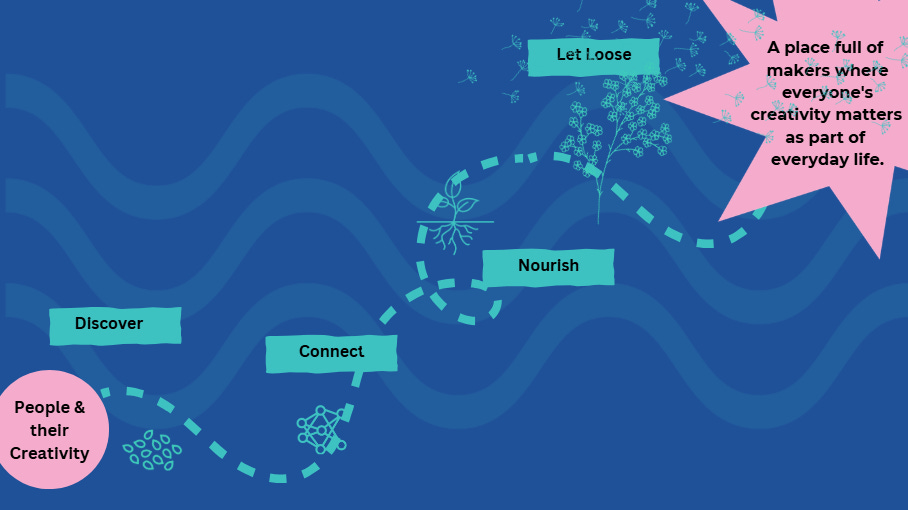
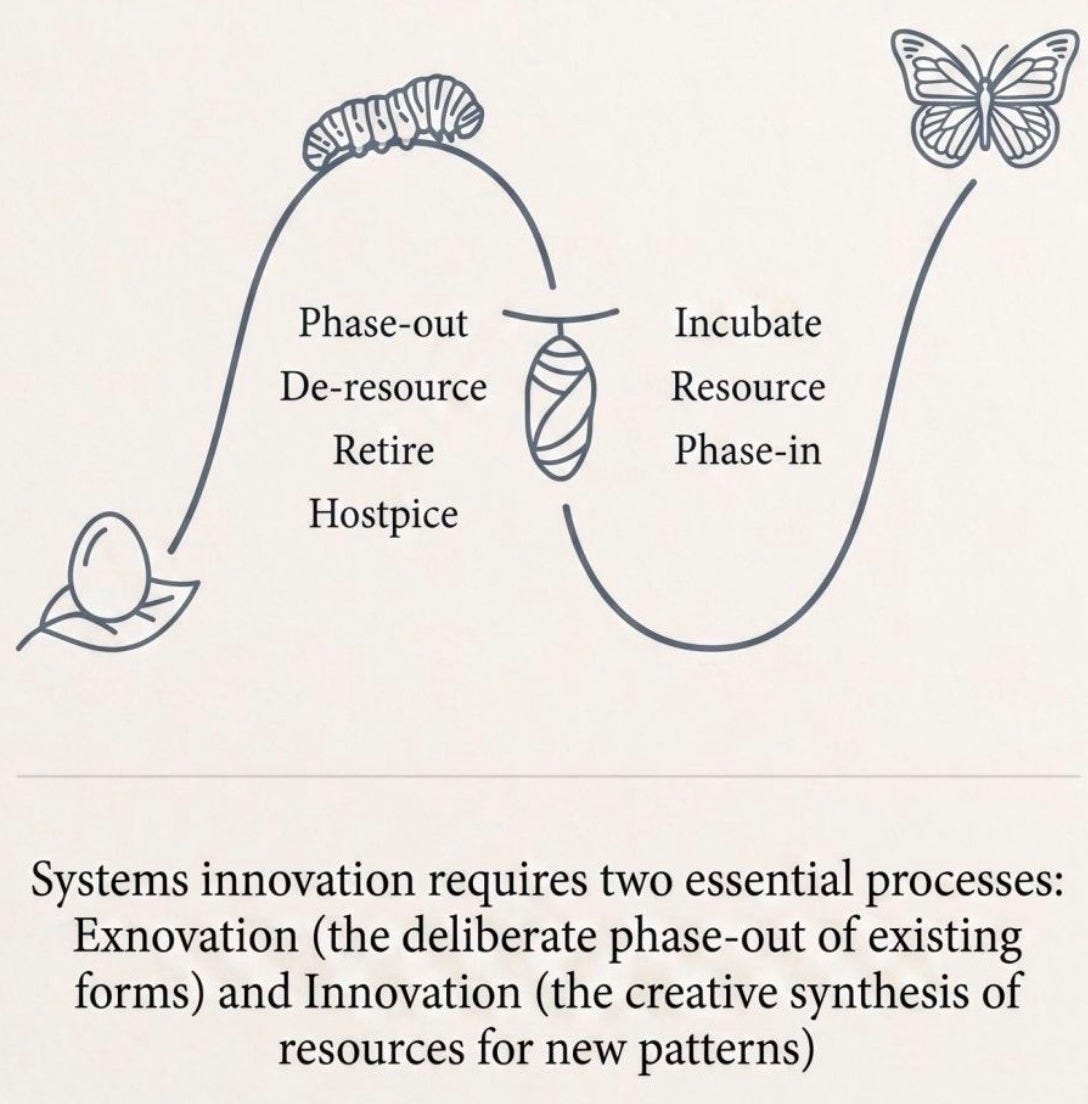
This phasing was inspired by Donna Meadows and the Berkana Institutes Two Loop Model, conceived to help people think about how and where to intervene in complex “living” systems - like communities & neighbourhoods - to contribute to beneficial change. You can read a bit more about this tool here
After two years focused largely on discovery and connection there is so much learning to digest and some really fertile ground from which to explore what might feel possible now. Bringing together emerging networks of people, groups and organisations to nourish and let loose a new phase of work.
Talking about possibility always feels exciting, but the tricky thing about transition is that we also have to learn how to let go. This was a big theme in our spring reflections and it continues as an ongoing challenge that we’re grappling with. Learning how to discern between what needs to be honoured, nurtured and protected and what needs to be released and let go. This is definitely not easy stuff. People and initiatives all have different rhythms and cycles, that don’t fit neatly into the same approach. Building momentum for new ideas can be hard and it can take years for new initiatives to really take root. Stopping too soon can be wasteful. Communities have also been at the sharp end of long histories of short termism, loss, withdrawal, decline and abandonment. So there is always tension between the possibility of the new/unknown and the loss of what already exists/is known.
This is compounded by the really unhelpful ways in which we often talk about change …. “wiping the slate clean”, “starting from scratch”. These expressions and the ways of thinking that come with them, all hide the very real fact that nothing ever really disappears.
In ecosystems, what ends, becomes the nutrient base for what comes next. Rather than new possibilities being added in and displacing / replacing what already is. They emerge and grow. Programmes - like ecosystems - can also be cyclical. Designed not for the individual growth, expansion, scale and sustainability (of projects, outputs, teams and organisations), but for the creative vitality of a shared place. Taking responsability for building up healthier soil through both seasons of emergence + growth and seasons of letting go. Understanding the need for “yields” which contribute, nourish and revitalise the conditions not just yields of endless extraction and consumption.
What if … we stop focusing on controlling and sustaining (perpetuating?) outputs, and focus instead on tending to the compost. Trusting that new possibilities will root themselves when the soil is ready?
Looking Back - April to July
Over spring & summer we’ve been juggling the ongoing deliver of some of our programmes alongside taking time to connect, imagine, listen and learn together with a growing network of people, groups and organisations about what we’re learning and noticing and what that means for what we to do next.
On going programmes:
Throughout April and May workshops, events and residencies took place connected to our ongoing collaboration with county-wide Derbyshire Makes Festival:
Derbyshire Makes Festival in Heanor took place on 2nd May encourage people to get making, repairing, mending and sharing skills and delivered in partnership with Maison Foo and Furthest From The Sea
Platform Thirty1 worked with primary schools in Heanor as part of their Black Shale Local Cultural Education Partnership, joining forces with Infinite Wellbeing Community Centre to support early years music making.
Sustainable textile activist Abigail Wastie collaborated with Heanor Gate Secondary School. Working with Sixth Form students to design and make sustainable school uniforms from British wool, taking part in workshops, visits and talks about British wool with 5th generation Derbyshire sheep farmer, Richard Spencer.
Claire, John and Sarah from Alfreton CAN partnered up with The Makory team from Derby Museums to host and manage a day of workshops in Severn Square in the centre of Alfreton. Welcoming hundreds of families onboard and sharing ideas about the future of the network.
Amanda Harran shared about flax growing in her Riddings front garden. Sharing 250 packets of flax seeds, hosting workshops about growing and processing flax and sharing heritage stories and objects exploring both the local flax industry and the different uses of linen from hose pipes and ship sails to house hold textiles and clothing.
Transition Phase
As we’ve already touched upon, most of our energy over this period has been focused on exploring how we can transition from what we have been doing towards what feels possible now. So much as changed since we initially developed the shape of the current programme. More connections. Deeper relationships. Increased trust. Steep learning curves from both what’s worked well and what hasn’t.
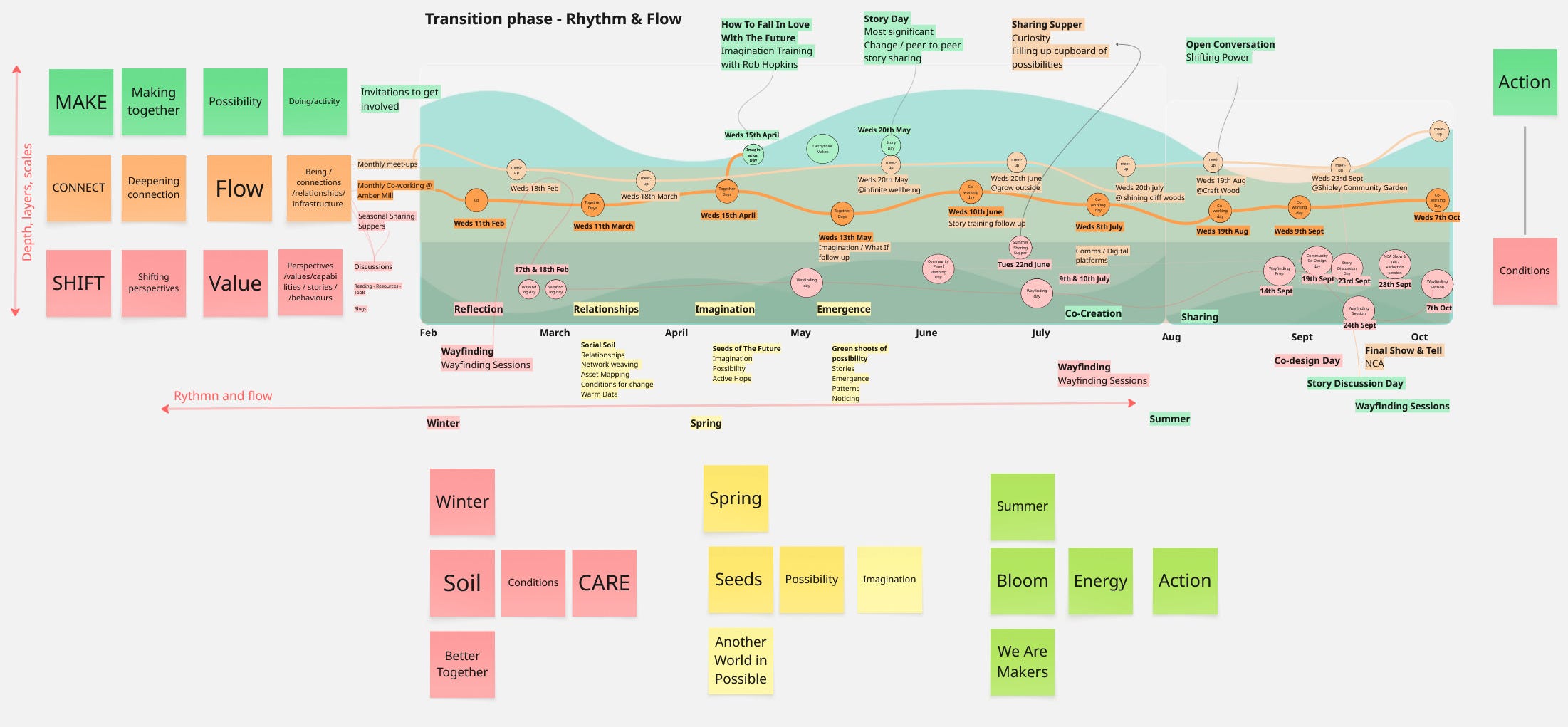
The initial transition phase planning was inspired by the rhythms of the seasons and their different energies. Working with the transitions between winter>spring>summer to help us to think about cycles, sequencing, rhythm and flow. We were also starting to play with how to represent the depth and layers of work. Rather than only sharing “activity” (what’s visible on the surface) we also wanted to honour all the underground work happening that is more focused on investing in the “soil” and creating the enabling conditions.
Below is a bit of a snap shot of what that looked like and some of the learning, ideas and questions we’re sitting with now:
Imagination - Rekindling our innate longing for what really matters
In April we hosted a full day ‘How to Fall in Love with the Future’ event with Rob Hopkins, bringing people together from across our emerging networks and generating more than 400 ‘what if’ questions together. Rob’s provocation that “longing on a mass scale if what makes history” has stayed with us. How can we fire up our deep longings and use them to power us beyond the narrow imaginal cul-de-sacs we seem to be stuck inside? Can rekindling our longing and doing more of what brings us to life help crack us open to the wonder of the past and the unknowable, surprising possibilities of the future?
This beautiful film by John Felix captures some of the longings that came alive in the room during our day together. As we move into a new phase how can we take forward learning from this day? Exploring how collective longing, imagination and action can be better aligned and help fuel each other.
Curiosity - “Filling up our cupboards of possibility”
During the Imagination Training we were encouraged to spend time “filling up our cupboards of possibility”. Recognising that we can only work with what we know and inspiring us to find more ways of making visible and connecting with viable futures that are already here in the present both locally and further afield.
We touched on the idea of connecting “What-If…” questions with tangible examples of existing initiatives - both near and far - so that people can get inspired by, learn from, join forces with and get behind what’s already happening. Starting with sparks, curiosities and questions that are relevant and alive in our place and from there “filling up our cupboards of possibility” through shared resources, trips, visits, conversations, talks and more.
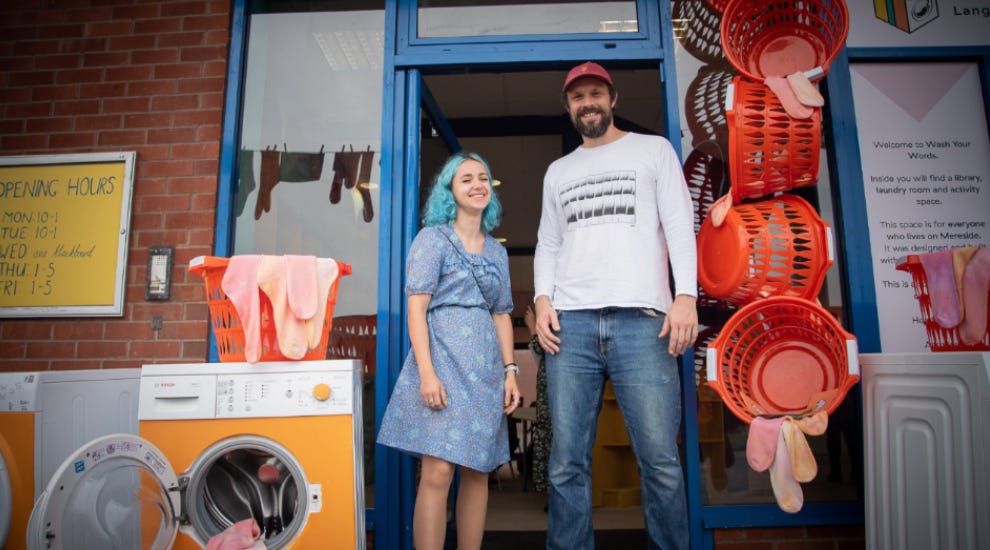
This is already happening through the seasonal “Sharing Suppers” that were kick started by Jodie as part of the Neighbourhood Creative Agents programme. With guest speakers invited to share what they’re up to where they live as inspiration for what might be possible here. In June we welcomed Tina Redford, former Director of LeftCoast Blackpool to share more about the story of “Wash Your Words” a Community owned Library and Laundry Room that has taken over an empty shop space. This connected well with emerging conversations around different community ownership models and how to share facilities as neighbours for both environmental and economic benefit? Wash Your Words: Langdale Library & Laundry Room - LeftCoast
Lots more to do on this front!
Relationships: “Attachment as a means to mobilise action”
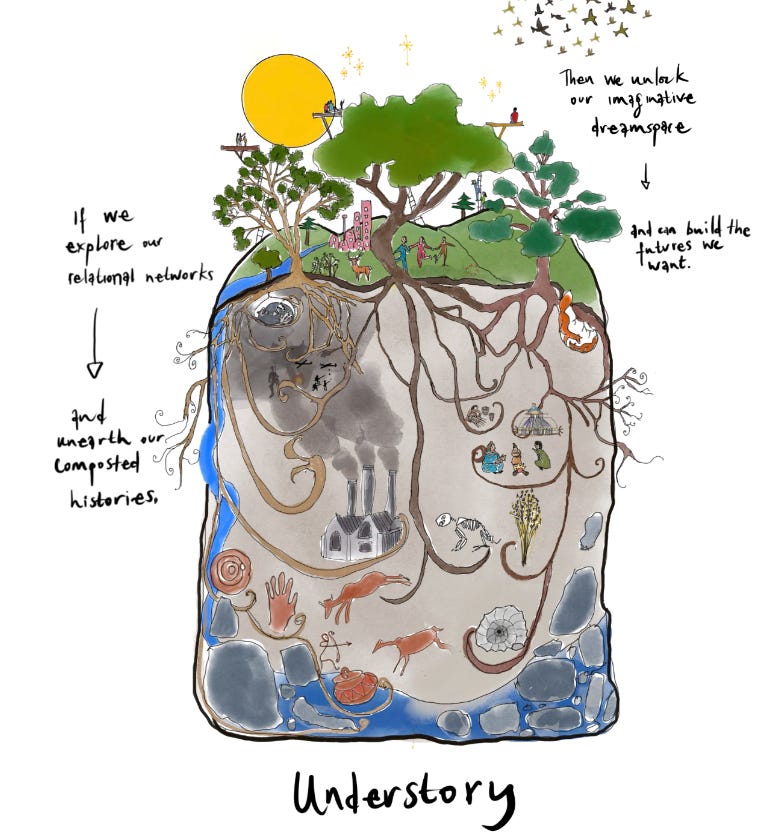
Nurturing stronger relationships with ourselves, our neighbours (both human and more than human) and the places we live continues to be a foundational part of how we think about mobilising the creative power of communities.
“If we explore our relational networks
And unearth our composted histories
Then we unlock our imaginative dreamspace
And can build the future we want”
Our ongoing collaboration with Understory underpins this part of our work with opportunities to share skills, build capacity, invest in network weaving and network mapping and experiment with creative technologies alongside our three other partner places (Onion Collective in Watchet, Co-Lab Dudley and Minehead and Coast Development Trust).
Listening - Paying attention to what’s often ignored
In June we hosted a “Storytelling for Evaluation” training day and over the summer we started out on our first “Story Telling for Evaluation” pilot. Five local people have been trained in story collecting, listening to their peers tell their stories, with 10 stories then written up by a local writer and shared back with everyone involved. In September we’ll come together for a Story Discussion Day to look at the themes and patterns and most significant changes that are emerging from the stories.
Story Telling For Evaluation Pilot:
- Training and support (June)
- Connecting peer story tellers and story collectors (July)
- Peer to peer conversation (Aug)
- Conversation recorded, transcribed and edited (Aug)
- Story Discussion day (Sept)
- Stories and learning shared (Sept)
Although we’re only part way through we’re already feeling the power of this approach to help unearth and pay deeper attention to what really matters to people, how unique and different everyone’s experiences are, and how powerful it can feel to be heard and listened to properly.
Wayfinding - Creating the conditions for new ways to emerge.
Over the past 6 months we’ve been working closely with a small group of collaborators who have been directly involved in leading parts of our work over the past 18months.
We all have very different approaches, backgrounds and experiences across heritage, health, horticulture, environment, arts, culture, sport, food and more. We each find a home in different sectors and we all have different ways of talking about how we work:
- Community First
- Asset Based Community Development
- Network Weaving
- Regenerative Design
- System Change
- Complexity Thinking
- Emergent Strategy
AND across all this difference, it feels like we’re all drawn towards shared ways of working. Starting with HOW we work not that WHAT we do. Deeply curious about how we are being / doing / learning in response to the unique possibilities of our place, context and positions at a time when business as usual is collapsing around us. I think we all have a felt sense that coherent action doesn’t require a grand plan imposed from outside or above. But that it emerges from accumulated action adapting as we go.
Interestingly, how we each define ourselves is largely based on WHAT we’re paying attention to (whether that be communities, assets, strengths, relationships, nature, systems, patterns, money, power …) rather than the underlying practice of tending to relational integrity and paying attention as a strategy in itself.
Two Strategies for finding our way:
Navigation = Knowing before you go = fixed outcome, a route planned in advance delivery against the plan. Goals, Targets, Intentions, Outcomes. Control. Certainty.
Wayfinding = Knowing as you go = paying attention, tending to context, adjusting in real time, orienting to what’s actually emerging instead of what we want/expect/predict.
I think coming together as peers to build our collective capacity to pay attention to the many different, diverse, interconnected parts of the complex living systems we all call home, is hugely exciting and powerful. Supporting and challenging each other to pay rigorous attention to relational integrity above our anxiety to control.
In phase one we worked together as part of a distributed delivery model. In phase two there is a growing sense of possibility that we can shift towards something different. What this looks like is still very much work in progress and it’s not been an easy process for anyone. But I hope we can find a way to both build our own skills and capacities and also hold space for new ways of working to be strengthened, shared, championed and protected in our place.
Distributed Power - Involving more people in making decision and taking action
Looking Forward - Autumn
Over Sept and Oct we’ll be looking to shape up some more concrete next steps informed by the transition phase and connected discussions and conversations happening in Sept including:
Story Discussion Day - September
Wayfinding Sessions - September & October
Neighbourhood Creative Agents - Show & Tell - September
Movers & Shakers Community Panel Co-Design Day - September
Meanwhile our regular monthly meet-ups will be carrying on including:
Monthly co-working days at Amber Mill in Oakerthorpe
Monthly meet-ups hosted with a different community venue each month
In October we’ll be hosting our first planning session in Heanor to start developing ideas for the next Derbyshire Makes Festival - Heanor on Saturday April 24th. And working alongside Maison Foo to get started with their new Heanor Story Gathers group to collect stories.
Stay connected:
Get in touch hello@wearemakeshift.uk
Check out our Monthly Updates for more info about upcoming activities and opportunities to get involved.
Go deeper by reading our Seasonal Reflections looking back at what we’re learning and noticing and sharing emerging plans here.