

What are we willing to let go of? And what becomes possible when we do?
In our Winter Reflections we shared the pull we were feeling to try and slow down, and resist being engulfed by the seemingly endless pursuit of more. More urgency, more content, more opinions, more data, more reading, more people, more stuff, more visibility, more knowledge, more learning, more sharing.
Inspired by winter, we wanted to step away from some of this and find time to digest what we’ve been learning and noticing from the past year. There was definitely a sense of overwhelm. A kind of indigestion. Surrounded by so much rich information, knowledge and insights, but without enough time and space to fully digest and integrate it into meaningful action and change.
Looking back now, winter’s pull to slow down, feels like it wasn’t so much about doing less, but more about the exhaustion that comes from “busying ourselves with work that the heart has already moved on from” (this is a quote from David Whyte in his beautiful writing about exhaustion Crossing the Unknown Sea).
This resonates deeply with where we’re at. The sense of possibility in the work we’re doing and the relationships we’re building is tangible. It calls longingly for us to go deeper. To leave the safety, familiarity and comfort of shallow waters and to wade out into darker, less familiar, unknown waters. Perhaps exhaustion seeps in, when we spend too much time in the safety of the shallows? Perhaps winter’s invitation to slow down was less about rhythm and more about depth?
“Ideas are like fish. If you want to catch little fish, you can stay in the shallow water. But if you want to catch big fish, you’ve got to go deeper. Down deep, the fish are more powerful and more pure. They’re huge and abstract. And they’re very beautiful” David Lynch
In reality slowing down has been much harder to do than it was to write about in a blog.
There is no quick fix for trying to slow down and go deeper within a context and logic that rewards productivity, busyness, rapid outcomes, forward motion, growth, urgency and the performance of success. Choosing to wade out into unknown waters is slow, dangerous and comes with no guarantees. The only thing that you can really be sure of, is what you’re going miss out on (all those lovely small fish!) The only real thing in your control, is the choice to let go and wait. Eeeek. There is both fear and possibility here.
Grappling with some of this personally and professionally over the past few months has been a humbling reminder that we can’t think about change as an “add on” to what already is. At whatever scale we’re working at, trying to add change on to what we’re already doing, just keeps us stuck inside exhausting cycles of overwhelm and burnout. It’s not possible to go deep and stay in the shallows. To have the small fish and the big fish. To find stillness with a racing mind. To contribute to the new whilst staying loyal to the old. This is the frustrating paradox that we all seem to be struggling with in different ways right now. A genuine longing for change and sophisticated built in safety mechanisms against it.
If we’re willing to accept that change isn’t something we can do, make, control, drive, bolt on, add-in, consume, deliver, extract or strive for … we have to also sit with the uncomfortable fact that perhaps change only becomes possible (maybe even natural, easy, “out of control” ?) when we let go of what is keeping us stuck. A dear colleague and collaborator often talks about us being our own worst enemies and “getting in our own way”. Over the past few weeks this expression has really landed differently.
So, as we move into the spring, the wisdom of winter still feels very alive. Inviting us to keep thinking deeply about what we need to unlearn, let go of and release before change is possible. And what becomes possible when we do?
What we are willing to let go?
Where are we still sustaining patterns and behaviours that we want to transform?
What discomforts are we avoiding?
With these questions simmering away in the background, below is a deeper dive into some of what we’ve been doing and learning over the winter and a look ahead to what’s coming from up through spring and summer.
Looking back: Winter 2026
Creating Space
The idea of creating/holding/making space for people to do what matters to them has been central to our approach since we started out with Make/Shift.
“Creating space for people to make, do, create, repair, grow, share, care for and connect with what matters to them in the places that they live. Unleashing the maker in everyone and letting the creativity of Amber Valley loose”
It’s a core part of any asset or strengths based approach. But what does it actually mean and how might we all benefit from getting better at creating space for appropriate action to unfold in context rather than imposing predefined actions?
In a traditional delivery model, action tends to be shaped in response to predefined outcomes and delivered in a top down way. We decide what matters and then try and make it happen. At whatever scale, whether it be a person, team, programme, organisation, sector, gouvernment. We use our power to deliver something directly. Providing. Owning. Controlling. Taking responsability. Deciding in advance what we will do, for who, and delivering this as efficiently as possible. In more collaborative models, insights might be gathered from people to shape and inform what is delivered, but the power and resources to take action are retained. And potential benefits/beneficiaries are limited by delivery capacity.
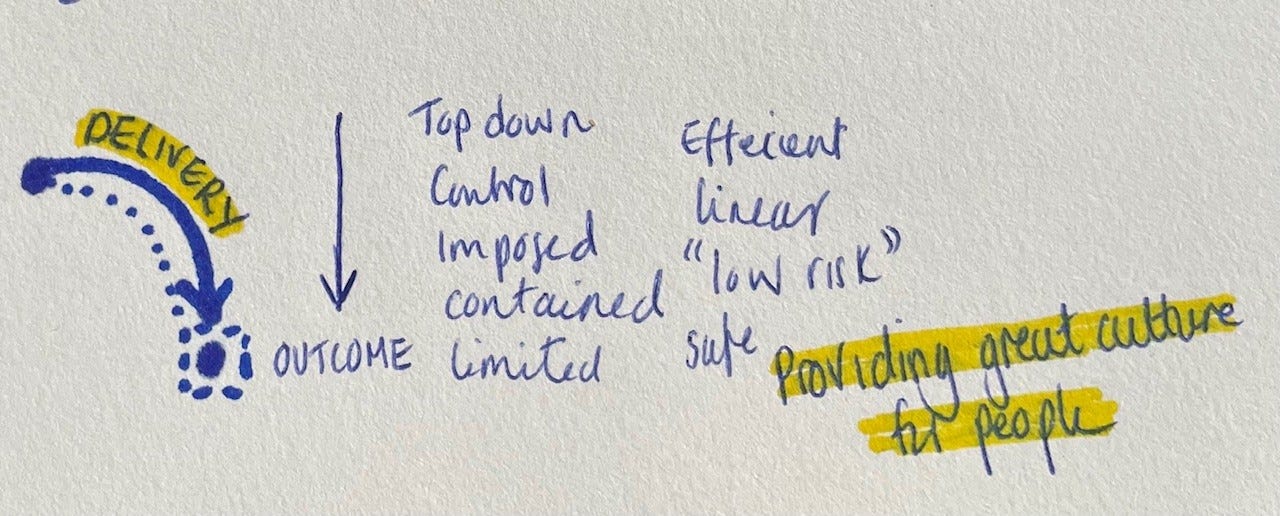
In contrast, when we talk about “creating space” the ambition is to make an intentional choice to use our power differently. Not to act, but to create the conditions for actions to emerge.
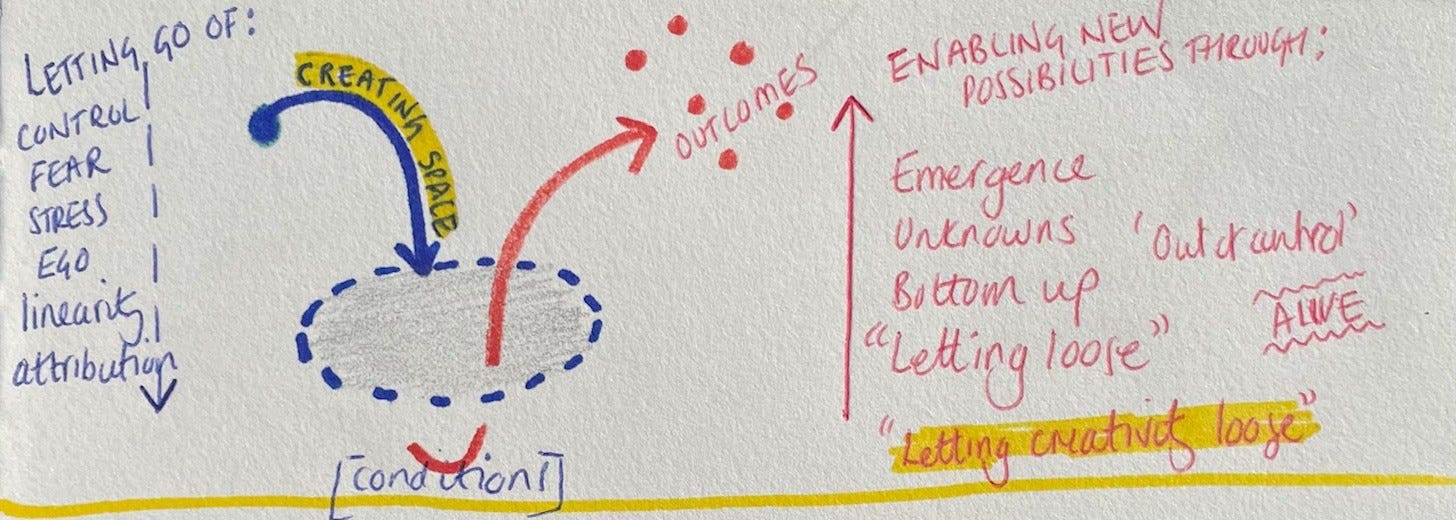
In our approach we talk about creating space in many different ways and at different scales across different invitations to Make, Connect, Shift.
Creating space for ourselves - the act of making, doing, growing and creating - can be seen as a way of “creating space” to reconnect with ourselves, our passions, experiences and talents. »» Movers & Shakers Community Fund
Creating space for others - learning and practicing how to be facilitators and “alongsiders” we can use our power to create space for neighbours to reconnect with and share their collective passions, experiences and ideas »» Neighbourhood Creative Agents
Creating space for new “ways” - coming together to share and learn with peers we can use our collective power to create space for new ways of being, seeing and doing to emerge »» We’re starting to think about this as “Wayfinding”.
From the consortium, to the team, to makers, collaborators & wayfinders we’re learning more and more about what this actually means and takes. Exploring what gouvernance and leadership could looks like if we were able to let go of command and control mindsets and shift towards the reality of “enabling without fully determining”.
This requires one non-negociable move. Decentring ourselves. And this, it turns out, is uncomfortable stuff. Honouring and dealing with the fear, anxiety, frustration, shame, invisibility, impatience, sense of “failure” and stress that comes up when working in this way is a big thing. We still have so much to learn about this and how we can create the better conditions for this to be named and worked through in generative ways. This is where we can each “get in our own way”, sabotaging possibilities for learning, growth and change, by defending ourselves against these uncomfortable feelings.
Two distinct loops of activity
Shifting our role away from project delivery and towards the creation of space and conditions for action, means that we can no longer claim a direct causation between what we do and what happens. This offers up a significant challenge to traditional impact evaluation models that are focused on the linear attribution of success to specific actions and interventions. It also presents significant challenges within the context of traditional reporting timelines which assume that input and output, activity and data collection, investment and outcomes are aligned within the same time period.
We’re starting to understand that within the context of this work there are two distinct loops of activity going on that each call for different ways of noticing. On the one hand, how we’re being & what we’re contributing. On the other, what’s emerging or changing. These two processes are interrelated but not directly connected in a linear, causal or time bound way. So rather than claiming “we caused this”, we’re invited to get curious about how our specific support interacts with context to enable change.
Thinking more about this helps explain why it can feel so hard to communicate about “what Make/Shift does”. (The dreaded question that still sends a shiver down the spine!) The whole point of this approach is that what happens is owned by the people doing it. Where this is working at it’s best and capacity is properly enabled, Make/Shift’s contributions are and should be invisible.
‘When the best leader’s work is done the people say, ‘We did it ourselves.’ Lao Tzu
This throws up all sorts of challenges and questions and brings us back to the idea that this work isn’t about adding new things into a context of deficit, but about enabling what already is (or wants to be), to exist more fully.
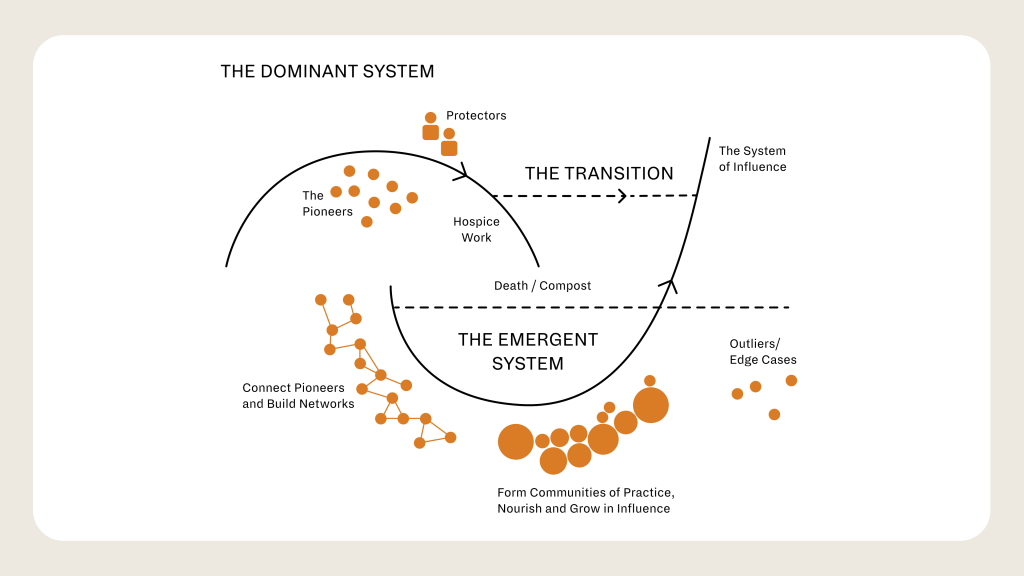
This framing also brings us back to one of the original change models that inspired our approach to change The Berkana Two Loop Model. But now, rather than thinking about systems as structures that are “over there” and looking at them from the outside in. We’re invited to sit with the reality that we all embody the systems we are trying to change through our everyday ways of thinking and acting. It’s fascinating to notice how similar this model is to some of the thinking above and how easily it can be applied to our own behaviours and ways of being. Creating space to compost ego & control and allowing different ways of being to emerge.
Ecologies of power
Much of our work over the past few years has been focused on exploring how we might contribute to cultivating conditions that enable ground up approaches to take root. Existing in the messy middle ground between where power and resources are currently held within the system and where they need to flow in order to support grass roots action. The Berkana Two Loop model reminds us that there is a role for everyone in this work, AND that everyone’s role is different.
“Pioneers, already on the fringes, experiment with new ways of thinking and doing. Protectors work from within the existing system to support these pioneers, while hospice workers help the old system decline gracefully, preserving what is valuable for the emerging new. The Two Loops model stresses that we require these multiple roles to guide us out from the old system into the emerging, regenerative future. In other words, not all of us have to be pioneers!”
Working with “Allies” on our consortium and beyond we have the opportunity to create the initial space needed to shift to a ground up model. This is where the biggest shift is needed. Intentionally using the collective power of partners to let go of control and invest in the infrastructure needed to reallocate power and resources away from them and as close to the community as possible.
Bringing together local peers to share and learn as part Wayfinding work, we can work together to create space to unlearn old ways and model new ways together. Anchoring this ground up approach in a collective, co-owned practice and protecting it from co-option. We’re starting to understand how important this part of the ecology is. Without this collective ownership and grounding the work becomes easily isolated, vulnerable, fragmented and dismissed. We’re lucky to be working with brilliant local partners as part of the Wayfinding group as well as national partners as part of Understory and can see this part of our work really growing and becoming stronger over the next three years.
Working with collaborators, to learn, develop and practice how to share skills, build capacity and become facilitators, network weavers, “alongsiders” within their community, we can support local people to create space for their neighbours to reconnect with and share their collective memories, creativity, passions, experiences and ideas.
Rather than being limited by top down delivery capacity and funding, this kind of ecosystem development, if contributed to by everyone at scale has the potential for “abundant” benefits to be nurtured from the ground up. Letting creativity loose to shape places from the inside out.
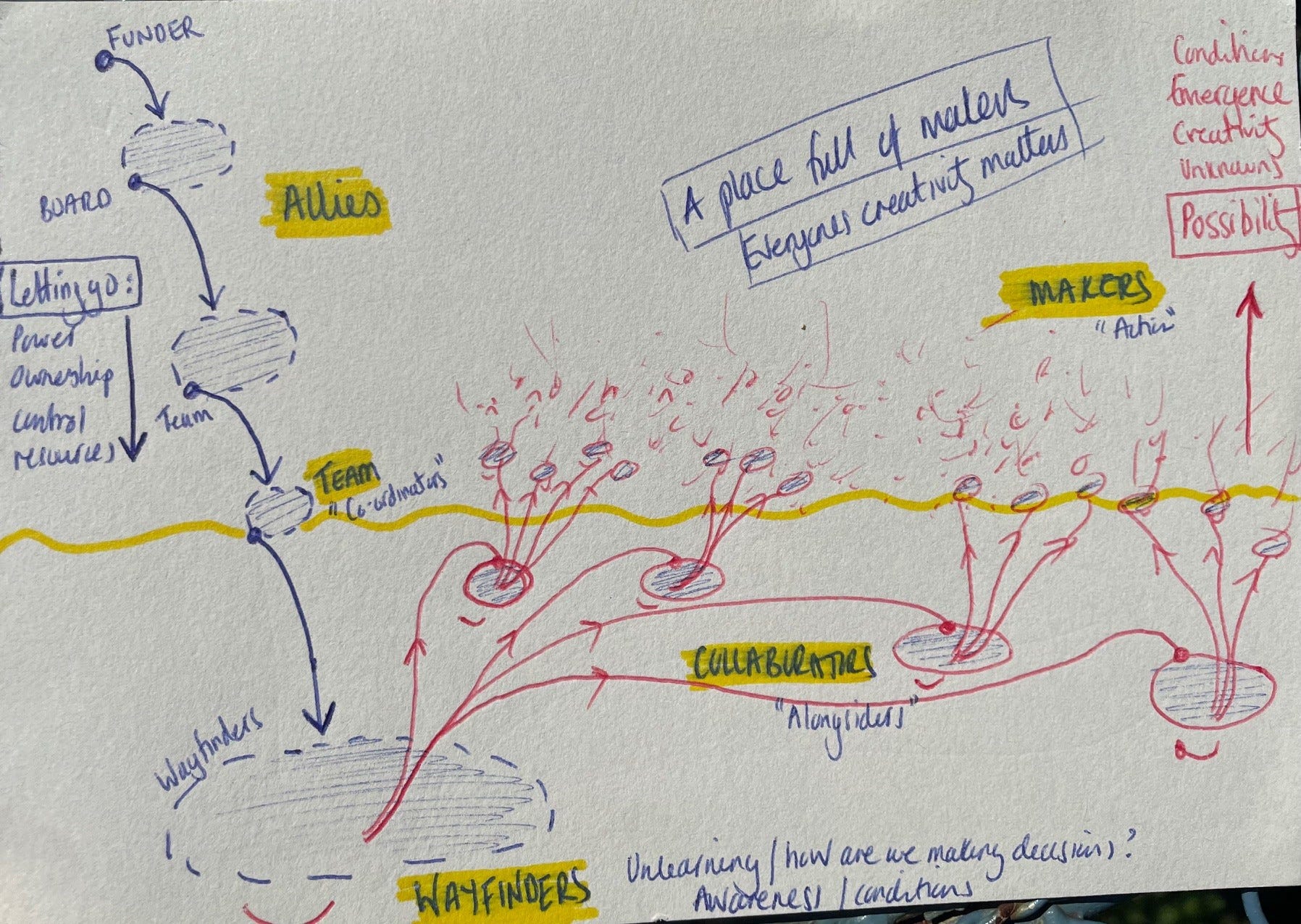
Much of this work can feel invisible, but tending to the “social soil” rather than extracting quick “harvests” feels more important than ever. Humbly recognising that non of us can do anything on our own, that we are all contributors within a complex system of collective action. Working with peers to hold ourselves to account for how we’re being and respecting the relationality of how diverse contributions pile up and compound over the long term in unexpected and surprising ways.
Investing in the enabling conditions for place based cultures and community-led ideas and creativity to unfold in context is definitely slower, harder and more unpredictable than providing culture for people from the outside in. It’s messy and we’re going to fail lots. And yet, as part of a wider conversation about equitable, resilient futures in the face of so many unknowns and so much instability, what if this is the only viable way?
Looking forward: Spring & Summer 2026
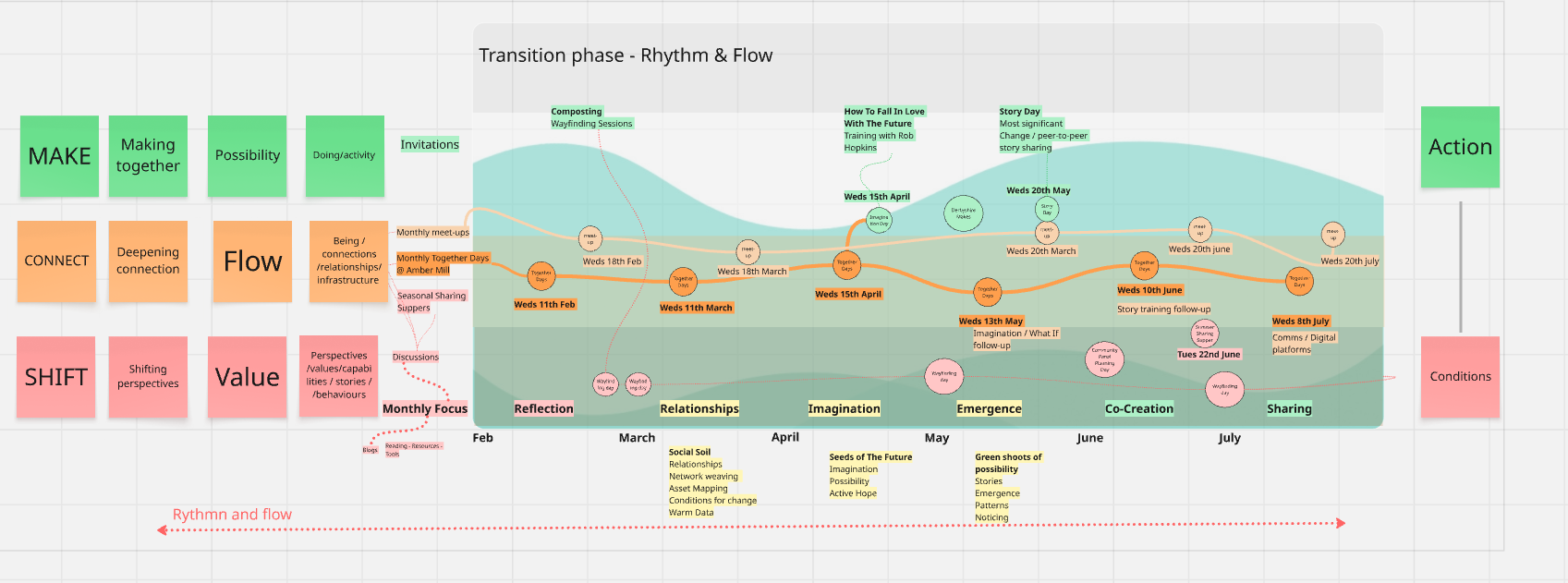
Transition phase:
How To Fall In Love With The Future Workshop with Rob Hopkins
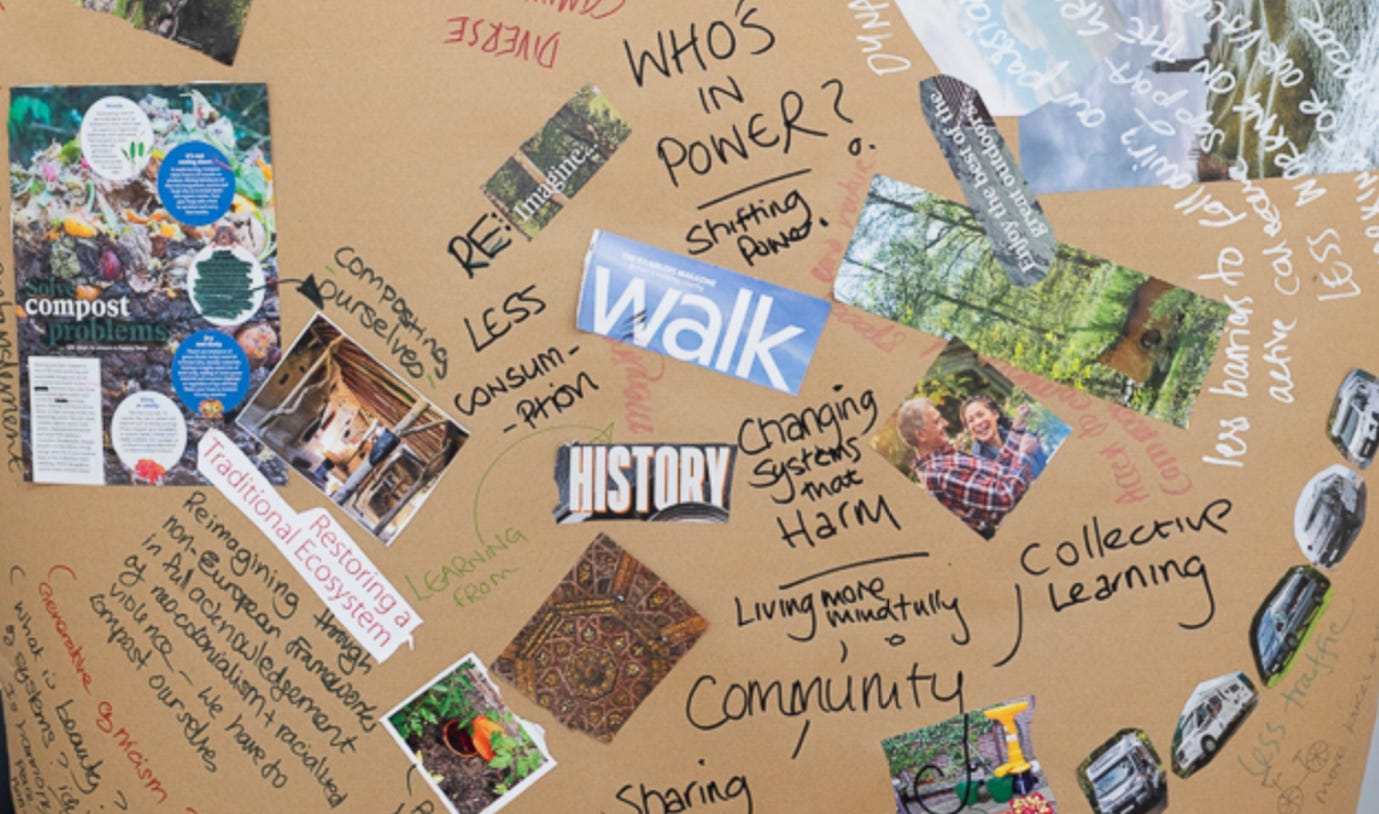
Last week we were delighted to welcome Rob Hopkins, co-founder of Transition Network and author of several books including ‘How to Fall in Love with the Future: a time traveller’s guide to changing the world’ to Derbyshire for the first time.
We were joined by 60 ‘time travellers’ to unleash our collective imagination as part of a day of “Imagination Training”. Inspired by the book, the event was hosted by Claire, Christine, Linda, Milly and John from the Movers & Shakers Community Panel alongside Rachel, Lizzie and Iona from the Make/Shift team.
Through Rob’s playful facilitation we used our senses to travel to the future and consider ‘What If …’. generating more than one hundred ideas including:
What if we were collaborative and not competitive?
What if public transport was owned by the community?
What if we could ‘mine’ positivity and creativity instead of extracting?
What if we connected regularly with people?
What if nature connection and growing was core learning for all?
What if we valued everyone’s contributions however big or small?
What if there were skill shares, libraries, collective community banks and community resources?
Images from the day are available to view here. And for anyone interested we’ll be hosting a series of “What Next” follow-up conversations as part of our Co-working Days at Amber Mill on Weds 13th May / Weds 10th June / Weds 8th July.
Networking and Storytelling Evaluation: Movers & Shakers
On Wednesday 20 May, 2-8pm, Story Day: Collecting Stories of Change will happen at Infinite Wellbeing Community Centre in Heanor. Co-facilitated by Chris Hayes, Lizzie and Gemma, all 3 rounds of Movers & Shakers and the Movers & Shakers Community Fund panel have been invited to an introduction to storytelling for evaluation, exploring how stories can help to understand the most significant change happening, and why this is important, supporting our collective learning and celebrating community-led work.
Movers & Shakers Community Panel - Planning day
In June everyone involved with the Movers & Shakers Community Panel will be coming back together for a day of planning. Taking stock of the last 18 months working of together to share £30,000 and supporting 33 local people to test an idea. Exploring ideas and starting to plan for how we might want to approach the fund over the next year.
Regular gatherings
Evening meet-ups for shared conversations, learning and strengthening connections, hosted by different venues across Amber Valley.
»Weds May 20th - Infinite Wellbeing Community Centre, Heanor
»Weds June 17th - Grow Outside, Butterley
»Weds July 15th - Shining Cliff Hostel, Shining Cliff Woods
»Weds Aug 18th - Craft Wood, South WingfieldMonthly co-working days - 10am -5pm at Amber Mill, Oakerthorpe
Come along to our monthly co-working day at Amber Mill to work independently, collaboratively, creatively, or take some time to read, craft, share food or enjoy a local stroll with others. For anyone curious they’ll be the opportunity to keep the conversations and connections going following on from the Imagination and Story training days in April and May.
» Weds 13th May
» Weds 10th June» Weds 8th July
For our Summer Sharing Super we’ll be joined by guest speaker Tina Redford, former Director of LeftCoast Blackpool, to hear about the story of “Wash Your Words”. A Community owned Library and Laundry Room housed in an empty shop space in Langdale.
If you’re interested in community ownership models and exploring how we can share facilities for both environmental and economic benefit, then this is for YOU!